
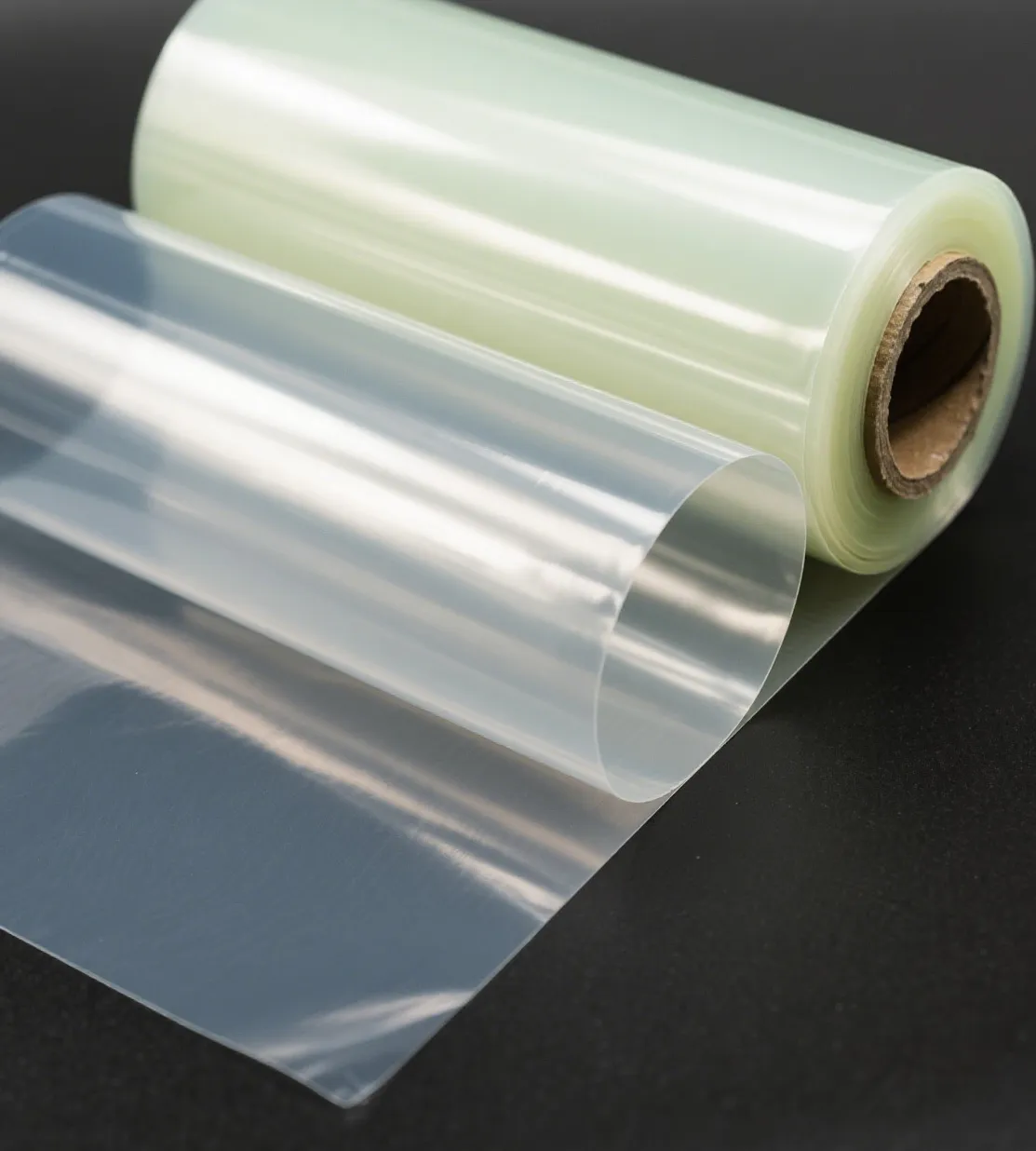
Polyether vs Polyester TPU Film and How to Choose Between Them
A Selection Framework Based on Contact Media, Temperature and Mechanical Duty
The polyether vs polyester TPU film decision comes down to what the film touches and how warm it stays. Polyether grades win wherever water, humidity or low temperature dominate; polyester grades win where abrasion, oil and mechanical load dominate. Almost every wrong specification comes from choosing on tensile strength alone.
This comparison covers the chemistry in brief, the performance differences that matter on a drawing, the processing consequences, and a trial method that produces a defensible answer instead of an opinion.
The Chemical Difference That Drives Everything Else
The soft segment is either a polyether or a polyester chain, and that single choice sets the film's relationship with water, oil and heat. Everything else, including hardness, additive package and thickness, adjusts the result but does not change its direction.
Polyether chains are built on ether linkages, which are chemically stable against water. Polyester chains are built on ester linkages, which give stronger intermolecular bonding and better resistance to non-polar oils and solvents, but are vulnerable to hydrolysis at elevated temperature and humidity.
Both are thermoplastic polyurethanes with the same hard segment chemistry, so hardness, colour and initial feel can be almost identical. The difference appears over time and under load, which is exactly why it cannot be judged from a sample held in the hand.
Polyether vs Polyester TPU Film Performance Compared
Polyether is the safer default for outdoor, wet and cold service; polyester is the stronger performer in dry mechanical duty. The table below is the short version that most specifications need, before any grade data is requested.
| Property | Polyether-based | Polyester-based |
|---|---|---|
| Hydrolytic stability | High | Low to moderate |
| Tensile and tear strength | Moderate | High |
| Abrasion resistance | Moderate | High |
| Oil and fuel resistance | Moderate | High |
| Low temperature flexibility | High | Moderate |
| Resistance to microbial attack | High | Low |
| Clarity and colour stability | Good | Good, grade dependent |
Two caveats matter. First, additive packages can shift individual values enough that the table should not replace grade data. Second, polycaprolactone grades occupy the middle ground and are often chosen when a single material must serve both a wet and a dry product family.
How Processing Behaviour Differs
Polyester grades are more sensitive to moisture before processing and need stricter drying; polyether grades tolerate a wider window but are not immune. Drying is the first process difference, and it is also the most common cause of a good grade performing badly.
Polyester melts tend to be slightly more forgiving in extrusion because of their stronger melt strength, which helps on thin gauges and wide dies. Polyether grades can be more sensitive to screw design and temperature profile, and they benefit from a line that is already stable rather than one being pushed to its limit.
Lamination and heat sealing follow the same logic. Polyester grades generally bond well to polar substrates such as polyurethane adhesives and some textiles, while polyether grades may need a primer or a different adhesive to reach the same peel strength.
- Check the drying specification before comparing prices, because a wet polyester grade will underperform a dry one
- Confirm the heat sealing window on the actual laminate rather than on the base film
- Ask whether the grade needs a primer for the intended substrate
- Run a short production trial before committing to a full roll order
Application Matching
Roofing, outdoor covers, cold chain and washable textiles point to polyether; conveyor belting, seals, dry industrial surfaces and fuel contact point to polyester. The application list below is short because most specifications fall into one of these patterns.
| Application | Usual choice | Reason |
|---|---|---|
| Roof and building membranes | Polyether | Ponding water and long humid exposure |
| Outdoor covers and tarpaulins | Polyether | Rain, UV and cold flexing |
| Washable textile laminates | Polyether or polycaprolactone | Repeated wet cycles and flexing |
| Conveyor and transmission belting | Polyester | Abrasion and load, usually dry |
| Hydraulic and pneumatic seals | Polyester | Oil resistance and dimensional stability |
| Frozen handling and cold storage | Polyether | Impact strength below freezing |
Common Specification Mistakes
The most expensive mistake is copying a grade from a datasheet without copying the environment that made it work. The second is comparing two suppliers' films at different hardness, thickness or test conditions and treating the numbers as equivalent.
Another common error is using a polyester grade in a washable or humid application because it tested better in a dry tensile test. The test was correct and the conclusion was wrong, because the test did not represent the service condition.
Finally, teams often change the soft segment and the hardness at the same time during a trial. That confuses the result: if the new sample performs differently, there is no way to know which change caused it.
A related error is specifying only the base film and leaving the adhesive, primer and seam to the converter. Those three components sit at the interfaces where water and stress concentrate, so a correct polymer choice can still produce a failed part if the bonding system was never matched to it.
How to Run a Fair Trial
Hold hardness, thickness and test method constant, change only the soft segment, and expose both samples to the real service condition. A trial that follows those three rules answers the selection question in one round instead of three.
- Define the service condition as temperature, humidity, contact medium and mechanical cycle count
- Produce both grades at the same hardness and thickness on the same line
- Test the finished laminate, including the seam and the edge, not only the flat film
- Keep one variable per trial round and record the production parameters for each roll
A trial that runs for a few weeks at ambient temperature will separate grades only when the difference is large. Where the service condition is humid or warm, an accelerated ageing step turns a preference into evidence, and it should be run before the order quantity is fixed rather than after the first complaint.
Where a roof membrane is bonded to fabric, the laminate construction often decides the outcome more than the base polymer. The base film used in roofing laminates is a useful reference for how substrate, adhesive and film have to be considered together.
Choosing With Manufacturing Support
A supplier that can make both chemistries is more useful than one that can only defend what it stocks, because the recommendation is not tied to inventory. That is the practical advantage of working with a film manufacturer rather than a trader.
Huanlong runs blown film, extrusion and foaming across 44 production lines from three bases, supported by two R&D centres and more than 30 engineers. Both polyether and polyester TPU film constructions can be reviewed against an application, with hardness and thickness held constant during the comparison.
Zhejiang Huanlong New Material Science Technology Co.,Ltd operates to ISO 9001:2015, ISO 14001 and ISO 45001 and holds OEKO-TEX® 100, Bluesign® and GRS certification. Send the service condition and the failing mode, and the material question becomes a testable one.
The short version: choose by contact medium first, temperature second, mechanical duty third. Then compare at equal hardness and thickness, and test the finished laminate rather than the base sheet.
If two grades both look acceptable on paper, the wetter and colder of the two service conditions should decide the trial.
Frequently Asked Questions About Polyether vs Polyester TPU Film
Can a polyether grade match polyester strength?
It can approach it at higher hardness, but the trade-off shifts to compression set and feel. The usual solution is to accept slightly lower strength and design the part with more section, rather than to force a polyether grade into a polyester duty.
Is polycaprolactone a true compromise?
It hydrolyses more slowly than conventional polyester and keeps more strength than polyether, so it is a genuine middle option. It is not equivalent to polyether in long humid exposure, and the ageing data should be read rather than assumed.
Does hardness change the comparison?
Yes, substantially. Hardness changes both stiffness and the ratio of hard to soft segment, so a soft polyester grade can behave differently from a hard one of the same chemistry. Comparisons are only valid at equal hardness.
Which grade is easier to heat seal?
Polyester grades generally seal over a slightly wider window and bond more readily to polar substrates. Polyether grades can seal well too, but the window is narrower and the seam should be validated on the finished construction.
What data should be requested from each supplier?
Soft segment type, hardness, thickness, tensile and tear data at the same test speed, ageing data at a stated condition, and heat seal strength on the intended substrate. Five items make the comparison honest.
Send the contact medium, the temperature range and the mechanical duty, and both chemistries can be assessed on the same basis. Huanlong can supply a comparison against the current TPU film range and propose samples produced under matched conditions.
Compare the TPU Film Grades Discuss Polyether vs Polyester TPU Film